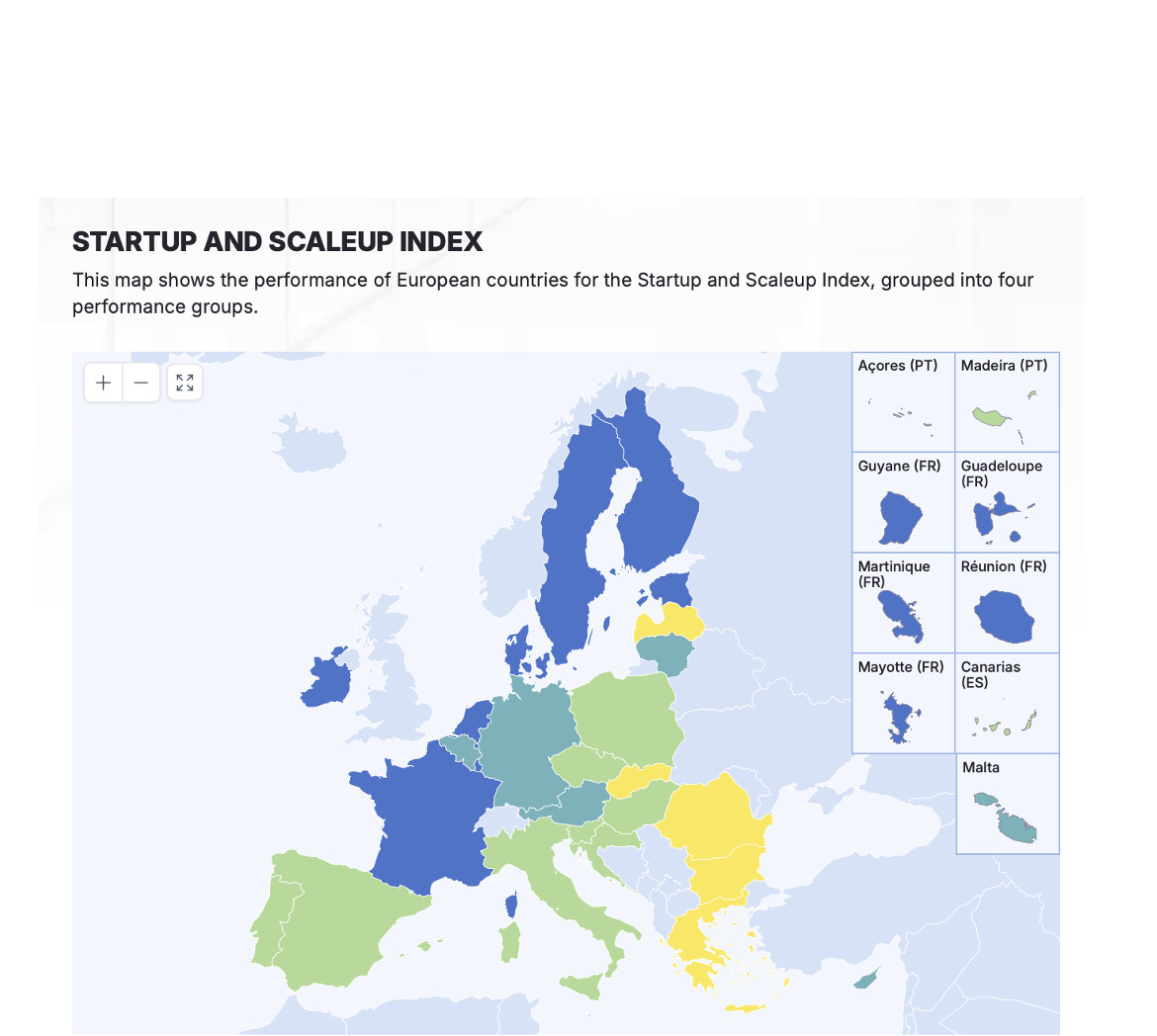
Finland ranks third among EU Member States in the first European Startup and Scaleup Scoreboard (ESSS), published by the European Commission. The result places Finland in Europe’s front-runner group and shows that its startup ecosystem is not only strong in individual areas such as finance and patents but performs consistently well across the full startup-to-scaleup lifecycle.
The ESSS is the official measurement tool of the Commission’s Startup and Scaleup Strategy “Choose Europe to Start and Scale”, launched in May 2025. The scoreboard will be updated annually, providing a comparable time series to track how ecosystems evolve in response to policy and market changes.
The ESSS has been developed by an international consortium led by 4FRONT together with EFIS Centre, Visionary Analytics, OneTandem and Dealroom under contract to the European Commission / EISMEA.
The ESSS in brief
The scoreboard consists of 36 indicators aggregated into six dimensions: innovation-friendly regulation; best talent; access to infrastructure, networks and services; better finance; fast market uptake and expansion; and impact. Country scores are indexed to the EU average in 2025 (EU = 100%), and countries are grouped into four performance tiers: front-runners (above 150%), high-performers (100–150%), catching-up countries (75–100%), and rising countries (below 75%).
Finland’s overall results: strong across all six dimensions
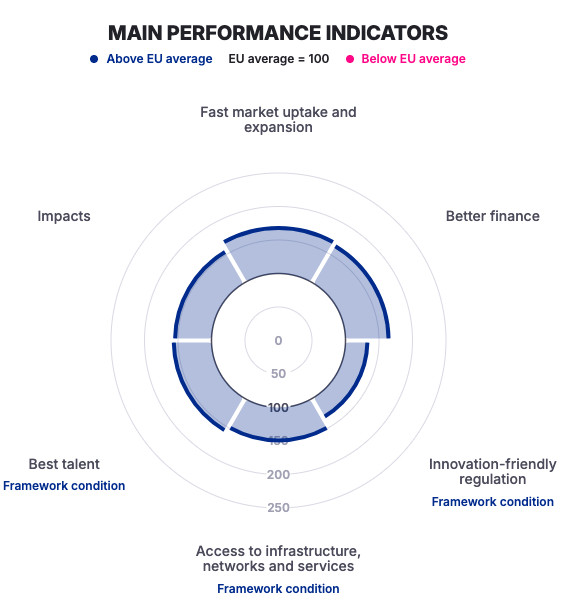
Finland’s most striking result is its breadth. Unlike many countries that excel in one or two dimensions while lagging in others, Finland scores above the EU average across all six dimensions, with no dimension falling below 132% of the EU average.
Finland’s strongest dimensions are fast market uptake and expansion (167.9%, rank 2) and better finance (164.3%, rank 3). Talent (156.3%, rank 9), impact (154.4%, rank 5) and infrastructure (149.2%, rank 8) are also well above the EU average. Even the weakest dimension, innovation-friendly regulation at 132.7% (rank 6), represents a position that most European countries cannot reach.
Finland’s strengths
Several individual indicators place Finland at the top or near the top of the EU rankings.
Finland ranks first in the EU for exits per capita (336.5% of the EU average), a signal of ecosystem maturity and a well-functioning market for acquisitions. Finland also ranks first for insurance and pension VC fund commitments as a share of GDP (236%), reflecting the deep involvement of institutional investors in the Finnish venture ecosystem. Early-stage VC investment stands at 204.7% of the EU average, meaning Finland’s startup formation pipeline is backed by more than double the EU norm in seed and early-stage capital. This is complemented by a high density of VC-backed companies (197.2%, rank 6) and strong total innovation procurement (136.7%, rank 1).
Finland’s patent activity is also exceptional: EPO patent applications per million population score 283.3% of the EU average (rank 3), and academic patents score 272.2% (rank 2), reflecting strong knowledge production and the capacity to commercialise research.
These strengths paint a picture of an Finnish ecosystem that creates well-funded, IP-generating startups at high rates and converts them into successful exits — the full arc from formation to value realisation.
The gaps which need attention
Despite its overall strong performance, there are several weak spots in Finland’s results:
- Late-stage venture capital is the most significant challenge. Despite exceptional early-stage investment, Finland’s later-stage VC stands at exactly the EU average (100%). This creates a structural scaling gap: Finnish startups are well-funded through their early years, but face capital constraints at their growth stage.
- International talent attraction is another structural weakness. Finland scores 98.3% of the EU average and is on rank 21 out of 27 on foreign-born people with tertiary education as a share of foreign-born employment, which is low –especially relative to its otherwise strong performance. Finland educates its own population well, and entrepreneurship education scores 207% of the EU average, but the ecosystem is not attracting skilled talent at a rate consistent with its overall ambition.
- The ESSS also points to a potential startup retention issue. On the indicator measuring startups founded in Finland that now have their headquarters outside the EU, Finland ranks 17th, with a score of 96% of the EU average.
- Finland appears to underperform in SME service exports: 53.6% of the EU average, rank 25. Despite strong innovation capabilities and high patenting activity, Finnish companies in service sectors are underperforming significantly in international market expansion. This points to a structural gap between innovation output and the capacity to scale it globally.
- Finland also scores below expectations on government R&D funding and tax support for business R&D: 31.4% (rank 19). This likely reflects Finland’s limited use of tax incentives for R&D and a strong focus on academic research in public R&D funding.
The ESSS dataset is rich and this article only highlights selected findings. The online tool allows country profiles, individual indicators and cross-country comparisons to be explored in full. The main report, in turn, provides a first analysis of the ESSS 2026 results.
The full ESSS, including the Finland country profile and interactive online tool, is available here.
The final report of the ESSS 2026 is available here.
The detailed methodological report, including data sources and statistical methods, is available here.
For more information on the ESSS, please contact Fabian Landes, fabian.landes@4front.fi