In 2021, 4FRONT launched the Sustainability Self-Assessment for companies together with the corporate sustainability network FIBS. The free online tool was created to meet an identified need to help especially small and medium-sized enterprises develop their sustainability work and recognise the potential related to it. The self-assessment tool gave companies of any size, industry or turnover a snapshot of their sustainability practices, concrete recommendations for development, and the ability to benchmark their results against other respondents.
In September 2026, we discontinued the tool for the time being. This is not because sustainability would have become less important – in our view, its significance has only grown. The tool had done its job and would now need updating, and developments in AI have given organisations new possibilities while also opening new opportunities for developing similar tools in the future. Sustainability remains an integral part of how we approach our work, and it will continue to feature prominently in our assignments.
The number of respondents exceeded our expectations
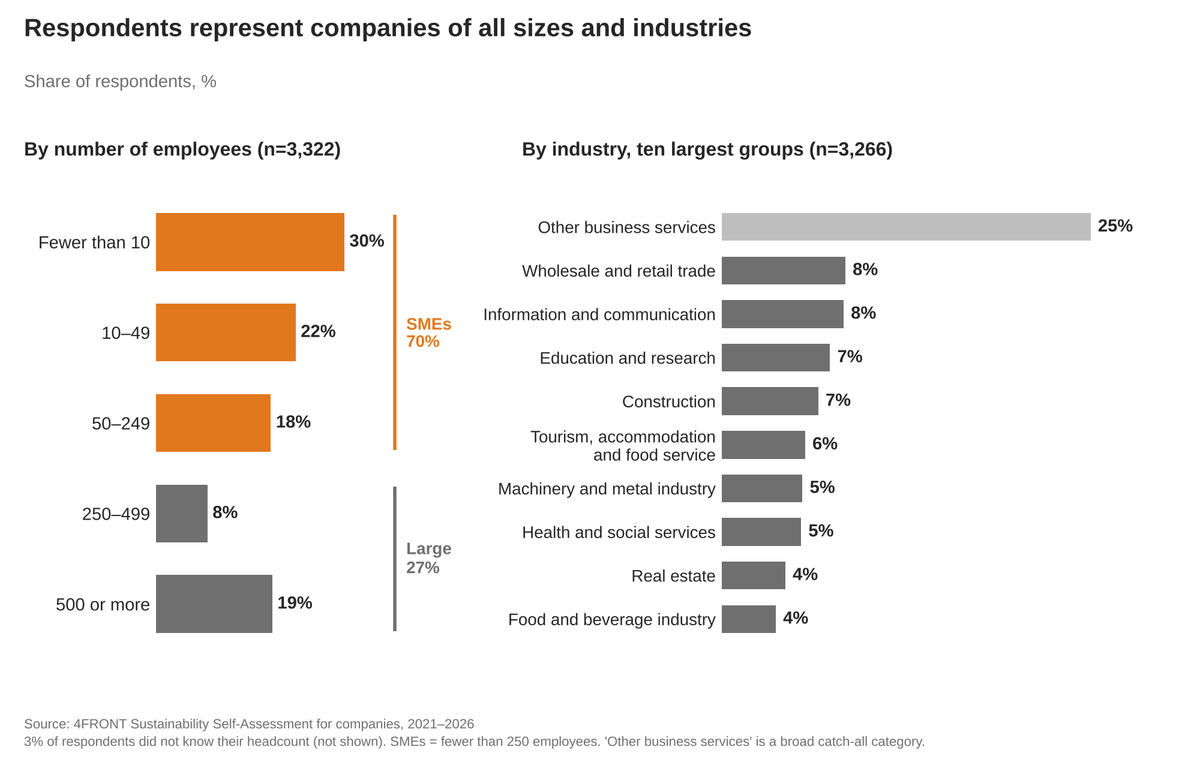
Respondents represent companies of all sizes. Small and micro-sized companies form the largest group (52%), and about 70% of respondents are SMEs with fewer than 250 employees, while 27% employ 250 people or more (n=3,322). The largest industry group is other business services (25%), followed by wholesale and retail trade (8%), information and communication (8%) and education and research (7%) (n=3,266).
Thank you to everyone who took part!
Looking back at the results gathered since 2021, a few findings stand out.
Scores have risen since 2022
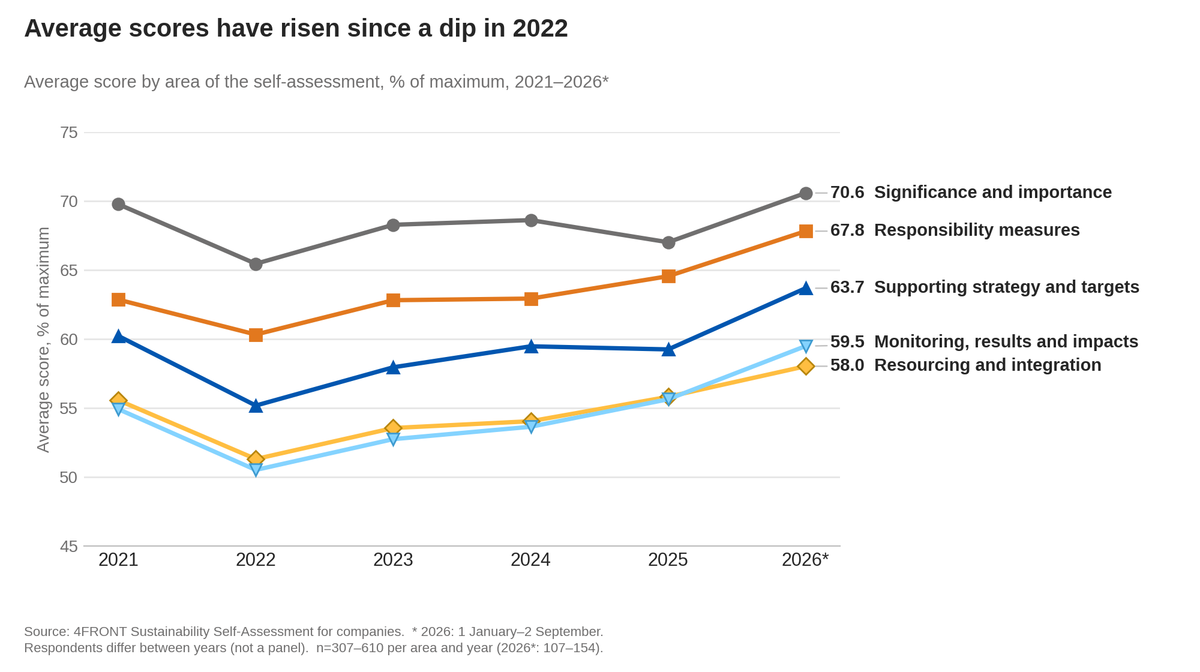
Looking at responses by year, the importance companies attach to sustainability has stayed at a similar level, while average scores for concrete measures have increased by about five to six percentage points between 2021 and 2026 in each of the environmental, social and economic areas of responsibility. Scores for strategy and targets, resourcing, and monitoring and results have also risen since a dip in 2022, with monitoring and resourcing remaining the lowest-scoring areas. However, the yearly comparison should be interpreted with caution: respondents differ between years, and 2026 covers the period from January to early September. The picture is the same when adjusted for company size.
Recognition of sustainability is high, but not yet visible in targets or strategy
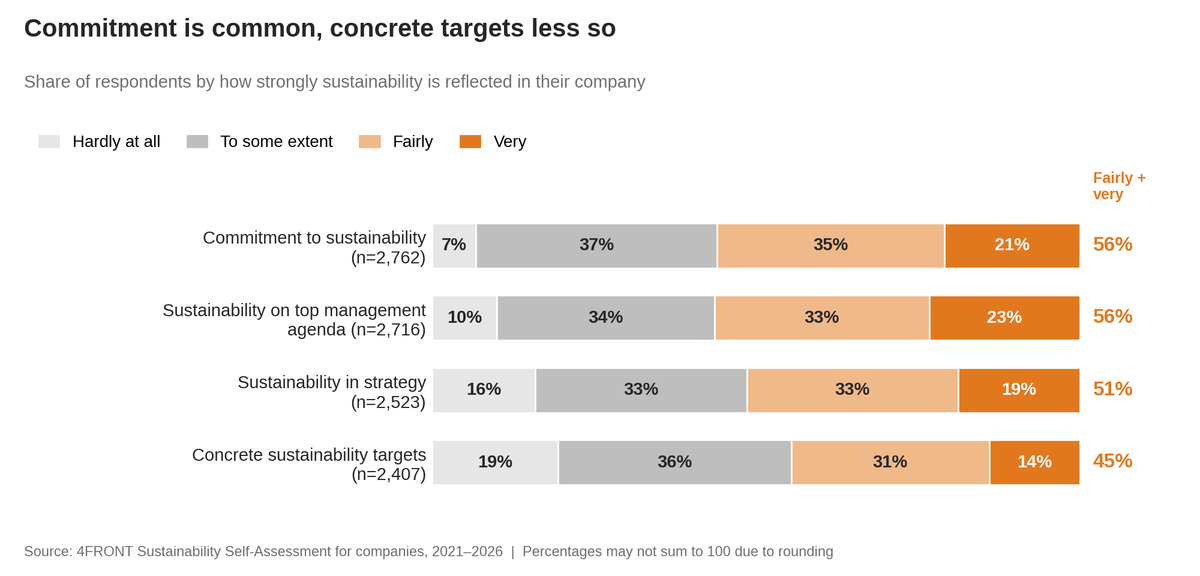
Around nine in ten respondents recognise the significance of sustainability at least to some extent, and a similar share report at least some commitment to it. Stronger commitment and concrete steering are less common: 56% report fairly or very strong commitment, 51% say sustainability is fairly or very strongly present in their strategy, and 45% have fairly or very concrete sustainability targets (n=2,407–2,762).
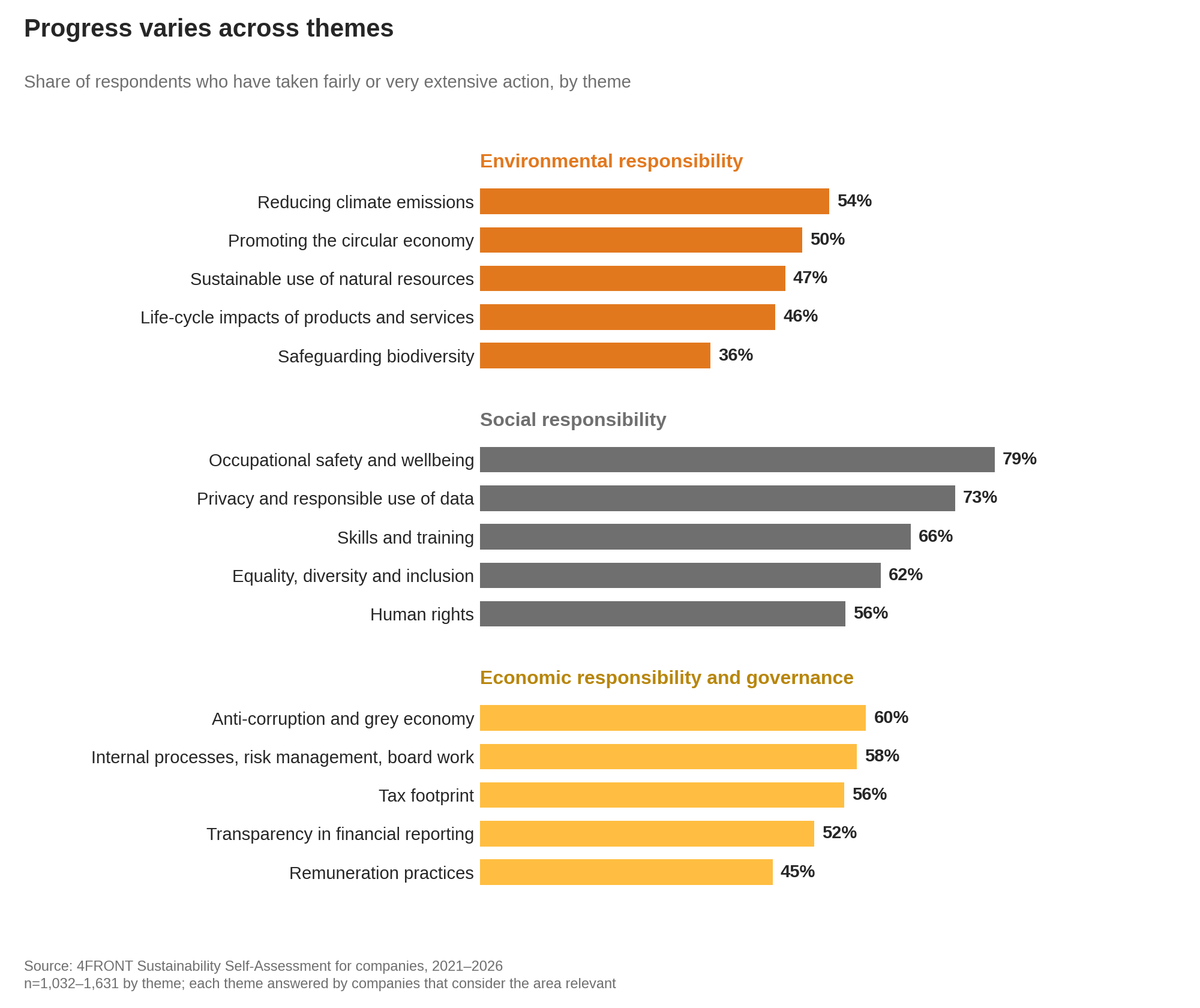
Progress varies across themes
Action is furthest along on social and governance themes, such as occupational safety and wellbeing (79%), privacy and responsible use of data (73%) and anti-corruption (60%). It is least advanced on safeguarding biodiversity (36%) and reviewing remuneration practices (45%). The chart shows the differences within each area of responsibility.
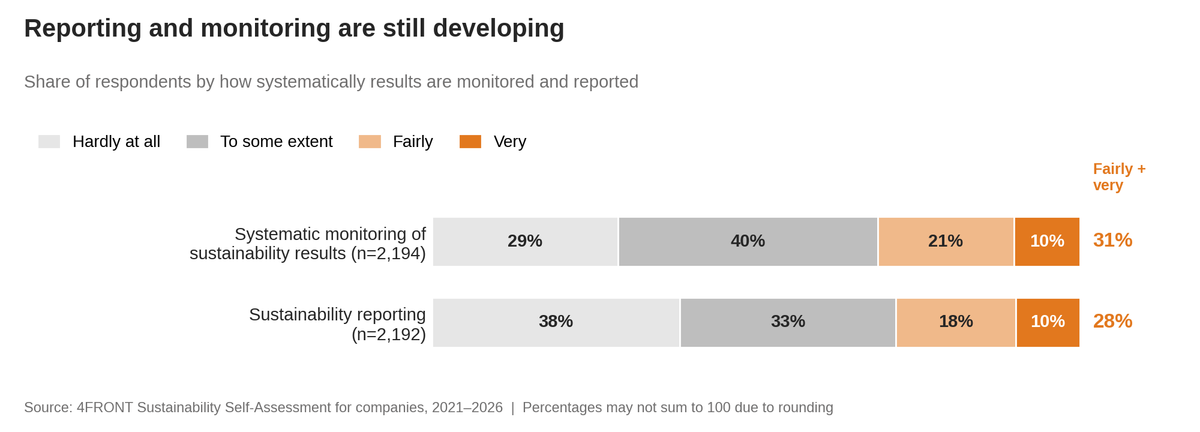
Reporting and monitoring are among the weakest areas
Reporting stands out: 38% of companies do not report on sustainability at all, and only 28% report fairly or very extensively (n=2,192). Systematic monitoring of results is also still developing, with 29% hardly monitoring at all and 31% following results fairly or very systematically (n=2,194).
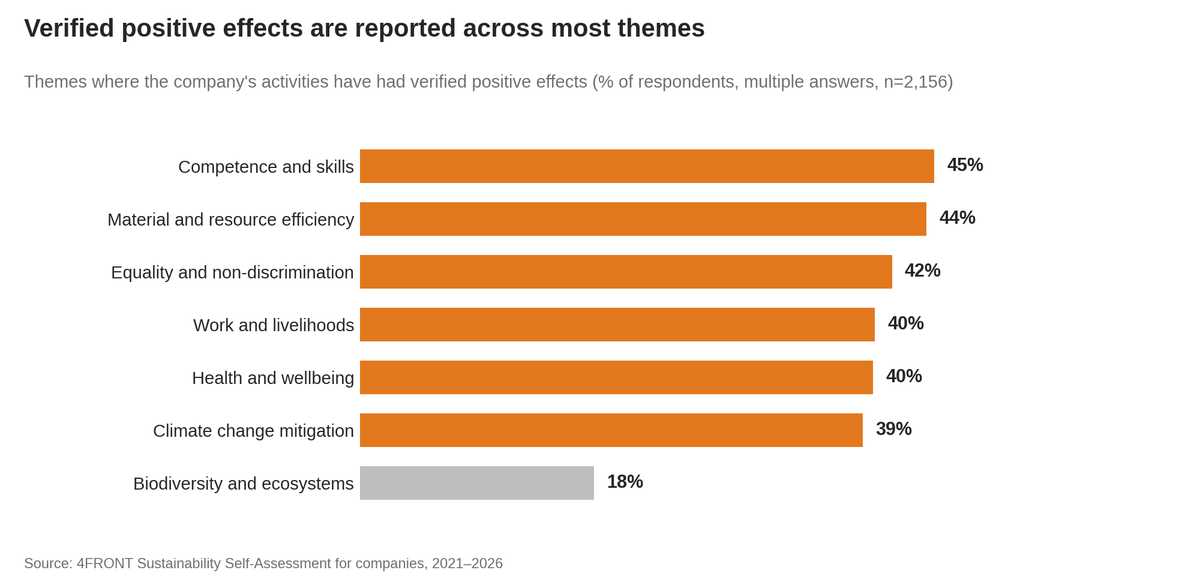
Positive effects are seen, but often modest
77% of respondents report at least some positive effects of sustainability on their business, while about one third (32%) report fairly or very large effects (n=2,166). Verified positive effects are reported most often in competence (45%), material and resource efficiency (44%), and equality and non-discrimination (42%) (n=2,156).
Besides the original tool for companies, we also developed a corresponding self-assessment tool for public and third-sector organisations, launched in 2023. Its use remained more modest, and it has been discontinued at the same time.
For more information, please contact: Vesa Salminen, vesa.salminen@4front.fi